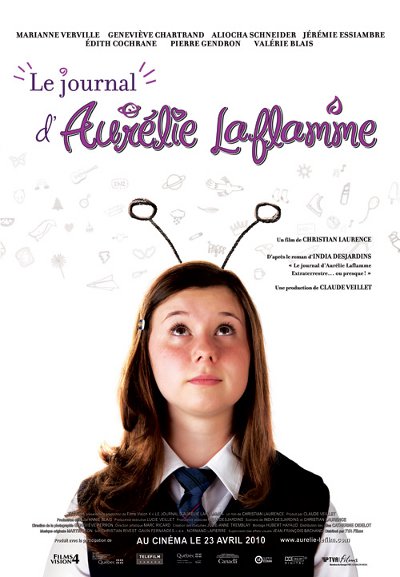
Journal d’Aurélie Laflamme, Le – Film de Christian Laurence

Le Journal d’Aurélie Laflamme est une comédie pour adolescents dont le personnage principal est tiré de la populaire série de livres écrits par l’auteure India Desjardins.

Le journal d’Aurélie Laflamme de Christian Laurence

Le journal d’Aurélie Laflamme de Christian Laurence

Le Journal d’Aurélie Laflamme est une comédie pour adolescents dont le personnage principal est tiré de la populaire série de livres écrits par l’auteure India Desjardins. Ce film est basé sur le premier tome de la série « Aurélie Laflamme, Extraterrestre ou presque ». Le réalisateur Christian Laurence vient du domaine de la télévision et signe ici son premier long-métrage de cinéma.

Comme on pouvait s’en douter d’après les succès obtenus par les livres, Le Journal d’Aurélie Laflamme fut reçu chaleureusement par le jeune public québécois qui en fit l’un des succès au box office de 2010. Au niveau international, le film de Christian Laurence eut droit à quelques sélections dans les festivals francophones, sans toutefois se démarquer outre mesure.

Un second film tiré des aventures d’Aurélie Laflamme a été produit par la suite.

Résumé

Aurélie est une adolescente de 14 ans, un peu perdue et donc en quête de solutions. Entre les habitudes de sa mère sédentaire et les chicanes avec sa meilleure amie, elle rêve à son premier french kiss ! Mais au fond, Aurélie se sent bien seule dans l'’univers, surtout depuis la mort de son père, il ya 5 ans.

Et si son père était simplement un extraterrestre, ayant quitté la Terre pour rejoindre sa planète? Génétique oblige, Aurélie serait elle-même une extraterrestre! Ceci expliquerait bien des choses. Par exemple, pourquoi elle se sent si différente des autres (surtout de sa mère), pourquoi elle n'’est pas capable d’'enligner deux mots sans faire une gaffe, et surtout pourquoi les garçons lui tapent vraiment sur les nerfs.

Synopsis officiel

Distribution

Marianne Verville (Aurélie Laflamme) ; Geneviève Chartrand (Kat) ; Aliocha Schneider (Nicolas) ; Jérémie Essiambre (Truch) ; Edith Cochrane (mère d’Aurélie) ; Pierre Gendron (Denis Beaulieu) ; Valérie Blais (Marie-Claude) ; Sylvie Potvin (Soeur Rose)

Fiche technique

Genre: Comédie dramatique - Origine: Québec, 2009 - Sortie en salles: 23 avril 2010 dans 83 salles au Québec - Durée: 1h48 - Classement: Général - Tournage: septembre-octobre 2009 - Budget approximatif: 4,1 M$

Réalisation : Christian Laurence - Scénario : Christian Laurence et India Desjardins, d'après le roman éponyme d'India Desjardins - Production : Claude Veillet et Lucie Veillet - Société de production : Films Vision 4 - Distribution : TVA Films

Équipe technique - Costumes : Julie-Anne Tremblay - Direction artistique : Marc Ricard - Montage : Hubert Hayaud - Musique : Martin Léon - Photographie : Geneviève Perron
Utilizing natural lighting and breathtaking landscapes.

The Sonnenfreunde brand later expanded to include the Sonderheft series, a line of special issues that debuted in the 1970s and ran until 1997. Over the course of more than 17 years, the series produced over 200 editions, establishing itself as a notable part of German publishing history. The typical Sonnenfreunde magazine had an editorial tone, featuring articles on topics like "Grundgesetz und FKK-Pressefreiheit" (Basic Law and FKK Press Freedom) and "Der FKK-Schmalfilm" (The FKK Small-Format Film), alongside the nude photo illustrations.

For decades, Sonnenfreunde has been a cornerstone publication in the German-speaking nudist community, offering a thoughtful blend of, photography, lifestyle, and philosophy centered around naturism. Known for its high-quality photography and respectful representation of the human body, the magazine consistently delivers both artistic and informative content. The latest continues this tradition, offering readers a fresh, in-depth look into modern nudism .

For the committed naturist, the answer is a resounding . For the curious newcomer, it is perhaps the finest introduction to European FKK culture available in English or German (the new issue is fully bilingual).

egieznA. Magazine érotique SONNEN-FREUNDE N°4 april 1996. Magazine érotique SONNEN-FREUNDE N°4 april 1996. Gebraucht | Gewerblich.

: Specialized meta-search engines like Eurobuch catalog rare paperbacks and out-of-print Sonderhefts originating from German antiquarian shops.

Modern nudist magazines often lean heavily into "lifestyle" or, conversely, pure erotica. The Sonnenfreunde Sonderheft represents a golden era when nudism was politically radical (standing against consumerist fashion) yet socially conservative (family-oriented). It is a historical document.

The new issue is expected to spotlight the best FKK destinations for the current year. This includes hidden beaches in Croatia, top-tier naturist resorts in Germany, and secluded spots in Southern Europe. C. FKK Lifestyle and Health Benefits

: Issues like Sonnenfreunde Sonderheft 226 (subtitled "Aus der Welt der FKK-Jugend" ) focused entirely on family life, showing generations participating in outdoor activities together to promote a body-positive upbringing. 3. The Modern Market: Collecting and Preservation

The Sonnenfreunde Sonderheft series remains more than just a historical footnote in publishing. It captures a specific era of European history characterized by a return to nature, a rejection of rigid societal dress codes, and the celebration of the human form in its natural state. Whether you approach these magazines as a cultural historian, a vintage ephemera collector, or an FKK enthusiast, they offer an unparalleled visual and textual record of a profound social movement. AI responses may include mistakes. Learn more Share public link

Finding the latest Sonderheft can be a mix of traditional and digital hunting.

Full-color saturation, glossy finishes, and action-oriented sport photography.

Depicting nudism as a wholesome, social activity.

Whether one is a lifetime FKK practitioner or someone exploring the philosophy for the first time, this publication acts as a curated guide to the principles of naturism. By documenting the movement's history while looking forward to its future, the Sonderheft ensures that the conversation surrounding body positivity and environmental harmony continues to thrive in the modern age. It remains a significant cultural artifact for those who believe that the simplest way to connect with the world is to do so without barriers. Share public link